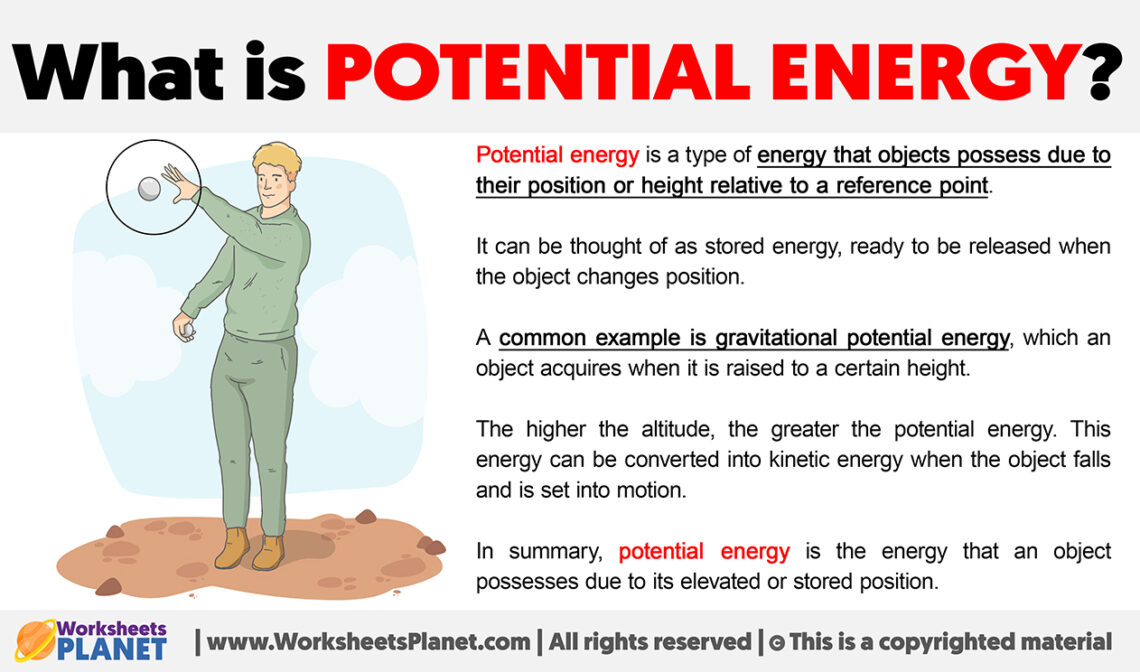
Potential energy definition is all about the energy that something has because of its position or shape. When an object is not moving but has the ability to move, it stores energy, and this energy is called potential energy. For example, a ball sitting on top of a hill has potential energy because it can roll down. The higher the ball is, the more potential energy it has. Similarly, when you stretch a rubber band, it has potential energy because it can snap back to its original shape. Potential energy is everywhere in our daily life, from water in a dam waiting to flow, to a stretched bow ready to shoot an arrow. Understanding potential energy definition helps us see how energy can change forms and do work, which is very important in science, engineering, and even in simple playground games.
Scientists divide potential energy into different types, like gravitational potential energy, elastic potential energy, and chemical potential energy. Gravitational potential energy is energy due to height and gravity. Elastic potential energy comes from stretching or compressing objects like springs or rubber bands. Chemical potential energy is stored in fuels, food, and batteries, and it can release energy when a chemical reaction happens. By learning about potential energy definition, we can also understand how energy moves and transforms in nature and technology.
What is Potential Energy Definition and Why It Matters
Potential energy definition is simply the stored energy an object has because of its position or shape. This energy is waiting to be used. It is important because it explains why objects move or produce power when released. For example, water stored in a dam has potential energy because it can flow down and turn turbines to produce electricity. A ball held at a height has energy because it can fall and roll. Even everyday items like a stretched rubber band or a compressed spring contain potential energy. Understanding this concept is the first step in learning how energy works in the world around us.
Types of Potential Energy: Understanding Potential Energy Definition
Potential energy definition is not just one type; there are different forms. The main types include gravitational, elastic, and chemical potential energy. Each type is important in daily life and science.
Gravitational Potential Energy
Gravitational potential energy is energy due to an object’s height above the ground. The higher an object is, the more gravitational potential energy it has. For example, a diver standing on a diving board has potential energy because gravity will pull them down. Engineers use this energy to design roller coasters, ski slopes, and dams. Gravitational potential energy depends on three things: the object’s mass, gravity, and height. This energy can change into motion or kinetic energy when the object starts moving.
Elastic Potential Energy
Elastic potential energy comes from stretching or compressing objects. Rubber bands, springs, and bows store energy when they are stretched or pressed. When released, this energy turns into motion. For example, a slingshot stores energy when pulled back and releases it to launch a stone. Understanding elastic potential energy is important in designing toys, machines, and safety devices like airbags.
Chemical Potential Energy
Chemical potential energy is stored in substances like fuels, food, and batteries. This energy is released through chemical reactions. For example, gasoline in a car engine contains chemical potential energy. When burned, it produces heat and motion, which powers the car. Similarly, the food we eat has chemical potential energy that our body uses for movement and growth. Learning about chemical potential energy helps in understanding nutrition, engines, and electricity generation.
How Potential Energy Changes into Motion
Potential energy definition is closely related to kinetic energy, which is the energy of motion. When potential energy is released, it changes into motion. For example, when a ball rolls down a hill, its gravitational potential energy becomes kinetic energy. A stretched rubber band snaps back and moves an object, changing elastic potential energy into motion. This transformation shows that energy is never lost; it just changes forms. Understanding this process is essential in physics and helps engineers design safe and efficient machines.
Examples of Potential Energy in Daily Life
Potential energy definition can be seen everywhere. Some common examples include:
- Water in a dam ready to flow and produce electricity.
- A ball on a hill ready to roll.
- A stretched rubber band or compressed spring.
- A bow ready to shoot an arrow.
- Food stored in your body for energy.
- Fuel in vehicles waiting to power engines.
Observing potential energy in daily life helps students and kids understand how energy works. It makes learning science fun and practical. Even small playground activities like swinging on swings show potential energy turning into motion.
Why Learning Potential Energy Definition is Important for Students
Learning potential energy definition is important because it helps students understand the basic rules of physics. It explains how energy is stored, transformed, and used. By understanding potential energy, students can solve problems in science, do experiments, and understand technology better. It is also important in real life for safety and energy efficiency. For example, engineers must calculate potential energy when designing bridges, buildings, and vehicles to ensure safety.
Potential Energy Definition in Science and Technology
Potential energy is widely used in science and technology. It is the basis for designing machines, generating electricity, and building structures. Hydroelectric power uses the gravitational potential energy of water to produce electricity. Springs in clocks, cameras, and other devices use elastic potential energy. Chemical potential energy in batteries powers phones, cars, and electronic devices. Understanding potential energy definition allows scientists and engineers to harness energy efficiently and create new inventions.
Fun Experiments to Observe Potential Energy in Action
You can easily see potential energy in action with simple experiments:
- Drop a ball from different heights and observe how it rolls faster from higher places.
- Stretch a rubber band and release it to see how it moves objects.
- Lift objects and measure how much energy they have depending on their height.
- Observe water flowing from a tap or dam to understand energy transformation.
These experiments help students visualize potential energy and make learning fun.
Conclusion
Potential energy definition is the energy stored in an object due to its position, shape, or condition. It is everywhere in nature and daily life, from rolling balls and swinging swings to fuel and food. Understanding potential energy helps students, scientists, and engineers see how energy transforms and powers the world. By observing examples and doing experiments, anyone can understand potential energy in a simple way. Learning about it is the first step toward understanding physics, machines, and energy use.
FAQs
What is potential energy definition in simple words?
Potential energy is the stored energy an object has because of its position, shape, or condition. It is ready to do work or move when released.
What are the types of potential energy?
The main types are gravitational potential energy, elastic potential energy, and chemical potential energy.
How does potential energy change into motion?
When an object with potential energy moves or is released, the stored energy turns into kinetic energy, which is the energy of motion.